Case Study
MBTI Catfish
MBTI Catfish
An interactive experience that questions how personality tests like MBTI shape the way we see ourselves.
An interactive experience that questions how personality tests like MBTI shape the way we see ourselves.
Overview
Roles
Researcher, Interaction Design, Visual Design, Wireframing, Prototyping
Timeline
8 months
Tools
Figma, Illustrator
If a personality test can fit you into four letters, what parts of you had to be left out?

We’ve come to rely on tools like the MBTI to define who we are, to find clarity in chaos. But what happens when those four letters become a mask, reducing complexity, reinforcing social expectations, and selling identity as a product?
The MBTI offers a sense of certainty and belonging in a time where people are searching for quick ways to define themselves. Often used in educational, professional, and social contexts, psychometric tools offer users a sense of identity, clarity, and connection. But beneath their popularity lies a deeper concern: how these systems simplify complex selves, reward conformity, and reinforce systemic biases.
Beneath the categories lies a subjective framework shaped by cultural bias, commercial interests, and oversimplified psychology. In today’s algorithm-driven world, where identity is increasingly packaged, branded, and commodified, it’s crucial to question how these systems influence how we see ourselves and others. By surfacing these hidden dynamics, I hope to prompt deeper reflection on identity formation beyond the typologies presented.
Overview
Roles
Researcher, Interaction Design, Visual Design, Wireframing, Prototyping
Timeline
8 months
Tools
Figma, Illustrator
If a personality test can fit you into four letters, what parts of you had to be left out?
We’ve come to rely on tools like the MBTI to define who we are, to find clarity in chaos. But what happens when those four letters become a mask, reducing complexity, reinforcing social expectations, and selling identity as a product?
The MBTI offers a sense of certainty and belonging in a time where people are searching for quick ways to define themselves. Often used in educational, professional, and social contexts, psychometric tools offer users a sense of identity, clarity, and connection. But beneath their popularity lies a deeper concern: how these systems simplify complex selves, reward conformity, and reinforce systemic biases.
Beneath the categories lies a subjective framework shaped by cultural bias, commercial interests, and oversimplified psychology. In today’s algorithm-driven world, where identity is increasingly packaged, branded, and commodified, it’s crucial to question how these systems influence how we see ourselves and others. By surfacing these hidden dynamics, I hope to prompt deeper reflection on identity formation beyond the typologies presented.
Context
My interest in this topic stemmed from both personal experience and observation. I’ve noticed how quickly people memorize MBTI types and use them to label others, and found it comparable to horoscopes. Over time, this reliance began to feel less like self-discovery and more like self-reduction. MBTI Catfish emerged from this tension, driven by a need to question why these systems are feel trustworthy and what they obscure in the process.
"Personality types are like zodiac signs: mildly controversial but always entertaining."

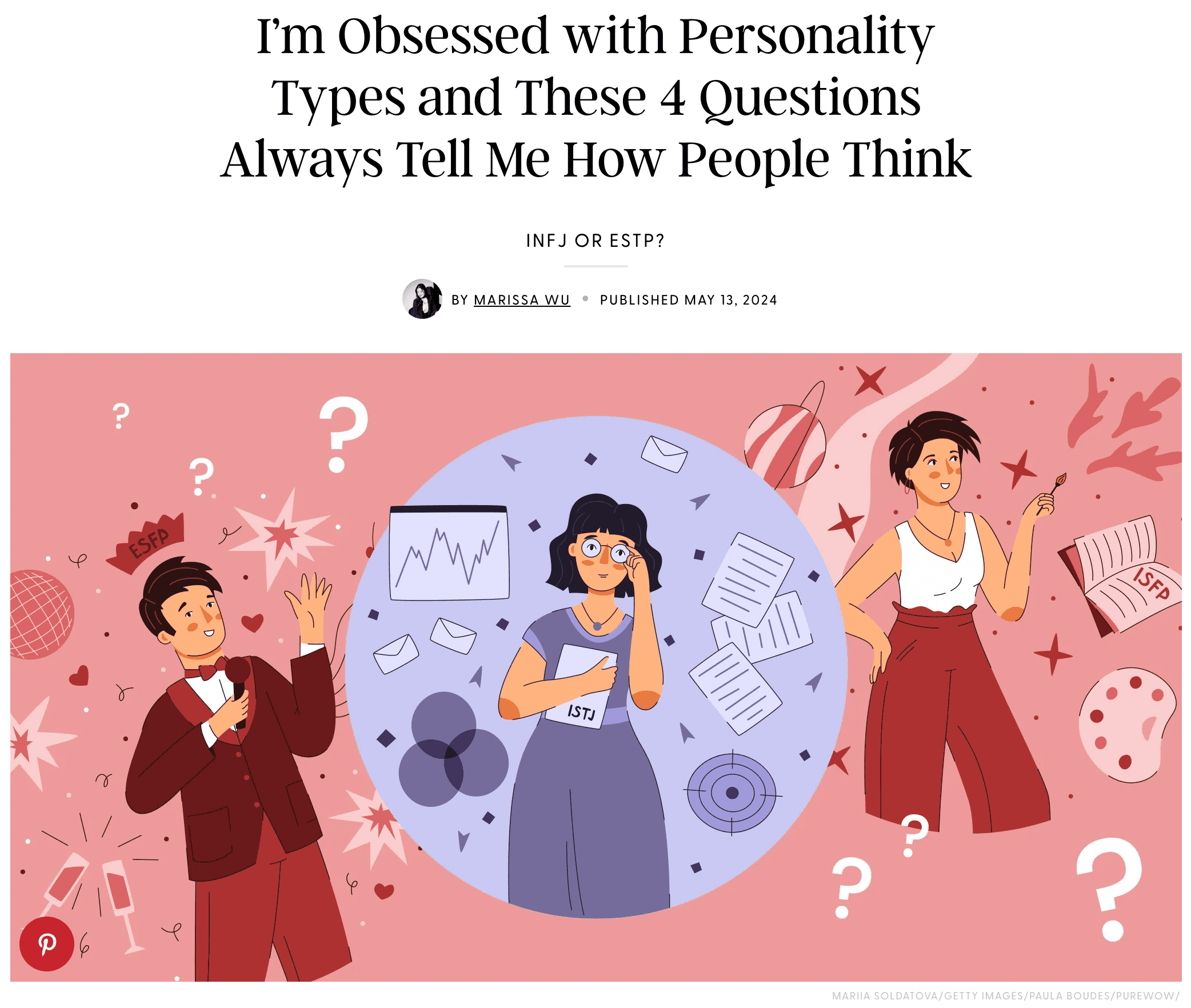
The "new" horoscope? MBTI
Personality tests like MBTI have become embedded in everyday life, appearing in workplaces, educational environments, dating apps, and casual social interactions. They function as shortcuts to self-understanding and social compatibility, offering tidy labels that feel comforting during moments of uncertainty.
Context
My interest in this topic stemmed from both personal experience and observation. I’ve noticed how quickly people memorize MBTI types and use them to label others, and found it comparable to horoscopes. Over time, this reliance began to feel less like self-discovery and more like self-reduction. MBTI Catfish emerged from this tension, driven by a need to question why these systems are feel trustworthy and what they obscure in the process.
"Personality types are like zodiac signs: mildly controversial but always entertaining."
The "new" horoscope? MBTI
Personality tests like MBTI have become embedded in everyday life, appearing in workplaces, educational environments, dating apps, and casual social interactions. They function as shortcuts to self-understanding and social compatibility, offering tidy labels that feel comforting during moments of uncertainty.
Framework
MBTI Catfish takes the form of an interactive website that mimics the familiar structure of an MBTI-style personality assessment. The interactive website challenges classification systems like the Myers-Briggs Type Indicator (MBTI).
Disguised as a familiar personality test, the experience gradually unravels through absurdism, disruption, and satire to expose how identity is reduced and shaped by systems that promise clarity but rely on subjective, culturally biased frameworks.
Aimed at young adults in transition who are between adolescence and adulthood—this project explores how tools like MBTI influence identity formation, self-perception, and interpersonal dynamics. Rather than presenting answers, it creates friction. It invites users to sit with discomfort, contradiction, and uncertainty, encouraging a reclaiming of identity as something fluid, contextual, and resistant to fixed labels—and to question why they felt compelled to fit themselves into them in the first place.
Framework
MBTI Catfish takes the form of an interactive website that mimics the familiar structure of an MBTI-style personality assessment. The interactive website challenges classification systems like the Myers-Briggs Type Indicator (MBTI).
Disguised as a familiar personality test, the experience gradually unravels through absurdism, disruption, and satire to expose how identity is reduced and shaped by systems that promise clarity but rely on subjective, culturally biased frameworks.
Aimed at young adults in transition who are between adolescence and adulthood—this project explores how tools like MBTI influence identity formation, self-perception, and interpersonal dynamics. Rather than presenting answers, it creates friction. It invites users to sit with discomfort, contradiction, and uncertainty, encouraging a reclaiming of identity as something fluid, contextual, and resistant to fixed labels—and to question why they felt compelled to fit themselves into them in the first place.
Problem Statement
Personality systems like the Myers-Briggs Type Indicator are widely trusted to define who we are, yet their simplifications often go unquestioned. By reducing identity to fixed categories, these tools can shape self-perception, reinforce stereotypes, and obscure the subjective and cultural biases embedded within them. There is a need for critical, experiential interventions that reveal these limitations and invite reflection beyond four letters.
Problem Statement
Personality systems like the Myers-Briggs Type Indicator are widely trusted to define who we are, yet their simplifications often go unquestioned. By reducing identity to fixed categories, these tools can shape self-perception, reinforce stereotypes, and obscure the subjective and cultural biases embedded within them. There is a need for critical, experiential interventions that reveal these limitations and invite reflection beyond four letters.
Research
Initial Research
This project began with a personal curiosity: Why do so many of us rely on tools like the MBTI to define who we are? And what are the deeper implications of trusting these simplified systems of identity?
Grounded in critical inquiry, the research began by examining the historical, psychological, and sociocultural foundations of classification systems like the Myers-Briggs Type Indicator.
Critical scholarship on classification systems revealed that these frameworks are not neutral. They are shaped by social, political, and economic forces, and become naturalized through repeated use. Literature critiquing psychometric tools highlighted concerns around validity, oversimplification, commercialization, and the reinforcement of stereotypes—especially when such tools are institutionalized in professional and educational contexts.
Initial Research
This project began with a personal curiosity: Why do so many of us rely on tools like the MBTI to define who we are? And what are the deeper implications of trusting these simplified systems of identity?
Grounded in critical inquiry, the research began by examining the historical, psychological, and sociocultural foundations of classification systems like the Myers-Briggs Type Indicator.
Critical scholarship on classification systems revealed that these frameworks are not neutral. They are shaped by social, political, and economic forces, and become naturalized through repeated use. Literature critiquing psychometric tools highlighted concerns around validity, oversimplification, commercialization, and the reinforcement of stereotypes—especially when such tools are institutionalized in professional and educational contexts.
Challenges
Does MBTI influence us or is it influenced? (very meta)
Initially, I struggled with defining the direction and critical stance of my inquiry into MBTI and similar classification systems. My initial research questions were grounded in an interest in how tools like the MBTI shape identity and social interaction, but I hadn’t yet fully unpacked or challenged the foundational assumptions of these tools. This tension revealed a deeper challenge: I needed to critically examine the validity and subjectivity of MBTI, rather than questioning it's legitimacy.
This feedback prompted a pivotal shift. I began to frame MBTI not just as a personality tool, but as a constructed system imbued with cultural norms, power dynamics, and commercial interests. From there, I could better define what I truly wanted to explore: not whether MBTI is right or wrong, but how its form, function, and perceived authority influence how we see ourselves—and how we are seen.
Challenges
Does MBTI influence us or is it influenced? (very meta)
Initially, I struggled with defining the direction and critical stance of my inquiry into MBTI and similar classification systems. My initial research questions were grounded in an interest in how tools like the MBTI shape identity and social interaction, but I hadn’t yet fully unpacked or challenged the foundational assumptions of these tools. This tension revealed a deeper challenge: I needed to critically examine the validity and subjectivity of MBTI, rather than questioning it's legitimacy.
This feedback prompted a pivotal shift. I began to frame MBTI not just as a personality tool, but as a constructed system imbued with cultural norms, power dynamics, and commercial interests. From there, I could better define what I truly wanted to explore: not whether MBTI is right or wrong, but how its form, function, and perceived authority influence how we see ourselves—and how we are seen.
Analysis
Caution should be exercised in internalizing these models due to the risk of over-reliance, oversimplification, and self reduction. These systems can also lead to larger systemic issues like marginalization, stereotyping, and exploitation, when implemented and institutionalized without further reflection of its implications.
Analysis
Caution should be exercised in internalizing these models due to the risk of over-reliance, oversimplification, and self reduction. These systems can also lead to larger systemic issues like marginalization, stereotyping, and exploitation, when implemented and institutionalized without further reflection of its implications.
Research Question
How do classification systems like Myers-Briggs Type Indicator (MBTI) perpetuate exploitation and marginalization through underlying structures and systemic biases, and what are the broader implications of their institutionalization in professional and educational settings?
Research Question
How do classification systems like Myers-Briggs Type Indicator (MBTI) perpetuate exploitation and marginalization through underlying structures and systemic biases, and what are the broader implications of their institutionalization in professional and educational settings?
Design Process
Design Process
Design Goals & Principles
SYSTEM FRAMEWORK
Maintaining user engagement while intentionally disrupting flow
Balancing familiarity and subversion, without breaking participation and engagement. The experience needed to feel trustworthy and recognizable enough to invite participation, while slowly destabilizing that trust to reveal the system’s constructed nature.
Ensuring absurdity was legible as critique rather than error
Making the disruptions feel intentional and as a design tool rather than as a mistake or error.
Revealing bias and arbitrariness
Surfacing the subjectivity behind the system without feeling instructive or didactic. The goal was not to reject MBTI outright, but to design a space where users could feel its limitations through interaction.
Avoiding total chaos that could obscure reflection
Provoking reflection without overwhelming users
Approach
MBTI Catfish mirrors the visual language and structure of traditional personality tests to establish familiarity. As users progress, the system begins to contradict itself. Questions grow increasingly presumptuous and unfiltered, pop-ups interrupt certainty, and visual order breaks down. The interface gradually abandons the grid, embracing disorganization, glitches, and exaggeration inspired by absurdist design principles.
The experience draws inspiration from interactive digital works that foreground impermanence and fragmentation, using visual overload and disruption as metaphors for unstable identity systems. Repetition and confirmation bias are intentionally employed to expose how easily users conform to frameworks once they are perceived as authoritative.
Approach
MBTI Catfish mirrors the visual language and structure of traditional personality tests to establish familiarity. As users progress, the system begins to contradict itself. Questions grow increasingly presumptuous and unfiltered, pop-ups interrupt certainty, and visual order breaks down. The interface gradually abandons the grid, embracing disorganization, glitches, and exaggeration inspired by absurdist design principles.
The experience draws inspiration from interactive digital works that foreground impermanence and fragmentation, using visual overload and disruption as metaphors for unstable identity systems. Repetition and confirmation bias are intentionally employed to expose how easily users conform to frameworks once they are perceived as authoritative.
Usability Testing
Prompt
"This is a new version of the MBTI test that promises to offer a deeper reflection of who you are. Try taking the test and explore the experience as you normally would. Be honest in your answers.”
The site is designed for young adults, a demographic particularly drawn to personality assessments during periods of identity exploration. The experience unfolds in stages:
Trust: A familiar interface encourages honest participation
Doubt: Interruptions challenge user certainty and self-assurance
Disruption: Visual and logical breakdown exposes system limitations
Reflection: Users are prompted to reconsider what the labels represent, and what they omit
Prompt
"This is a new version of the MBTI test that promises to offer a deeper reflection of who you are. Try taking the test and explore the experience as you normally would. Be honest in your answers.”
The site is designed for young adults, a demographic particularly drawn to personality assessments during periods of identity exploration. The experience unfolds in stages:
Trust: A familiar interface encourages honest participation
Doubt: Interruptions challenge user certainty and self-assurance
Disruption: Visual and logical breakdown exposes system limitations
Reflection: Users are prompted to reconsider what the labels represent, and what they omit
Goals
To evaluate whether users understand the experience as a critique of the MBTI system rather than a functional personality test, while remaining engaged long enough to reflect on how classification systems shape identity, certainty, and self-perception.
Goals
To evaluate whether users understand the experience as a critique of the MBTI system rather than a functional personality test, while remaining engaged long enough to reflect on how classification systems shape identity, certainty, and self-perception.
Outcome
Participants initially recognized the interface, comparing it directly to the MBTI personality test. This familiarity established immediate trust, interest. and elicited engagement. As the experience progressed, users began to notice disruptions in logic, tone, and visual structure, prompting them to question the validity of the questions and their own responses.
As visual and logical disruptions increased, some users experienced confusion or uncertainty about whether these moments were intentional. However, by the end of the experience, most participants recognized the disruptions as a deliberate critique, prompting reflection on how easily trust is granted to familiar systems and how context shapes both responses and identity labels.
Outcome
Participants initially recognized the interface, comparing it directly to the MBTI personality test. This familiarity established immediate trust, interest. and elicited engagement. As the experience progressed, users began to notice disruptions in logic, tone, and visual structure, prompting them to question the validity of the questions and their own responses.
As visual and logical disruptions increased, some users experienced confusion or uncertainty about whether these moments were intentional. However, by the end of the experience, most participants recognized the disruptions as a deliberate critique, prompting reflection on how easily trust is granted to familiar systems and how context shapes both responses and identity labels.
Challenges
1: Interface Severance and Pacing
Determining when and how to disrupt the interface without losing user trust or diluting the critique was a central challenge. Disruptions that were too subtle risked going unnoticed, while more aggressive interruptions could confuse or alienate users. Finding the right pacing between familiarity and disruption became a key design tension.
1: Interface Severance and Pacing
Determining when and how to disrupt the interface without losing user trust or diluting the critique was a central challenge. Disruptions that were too subtle risked going unnoticed, while more aggressive interruptions could confuse or alienate users. Finding the right pacing between familiarity and disruption became a key design tension.
2: User Interface Trust
Another challenge was deciding how much of the original MBTI structure to preserve in order to establish credibility and user comfort. The interface needed to feel legitimate enough for users to engage sincerely, yet unstable enough to reveal its constructed nature. This required carefully repurposing recognizable patterns and question formats so that trust was initially built, then gradually destabilized as the experience evolved.
2: User Interface Trust
Another challenge was deciding how much of the original MBTI structure to preserve in order to establish credibility and user comfort. The interface needed to feel legitimate enough for users to engage sincerely, yet unstable enough to reveal its constructed nature. This required carefully repurposing recognizable patterns and question formats so that trust was initially built, then gradually destabilized as the experience evolved.
Final
Outcome
MBTI Catfish does not offer answers or alternative classifications but rather reframes it as a cultural artefact. By inviting users to experience trust and doubt a familiar system, the project encourages critical awareness of how identity is shaped by external frameworks and exposes the invisible assumptions embedded in personality testing culture.
The project advocates for resisting reduction, embracing contradiction, and reclaiming identity as something dynamic and evolving. It is a call to slow down, question authority, and recognize identity as fluid, contextual, and continuously in formation.
Outcome
MBTI Catfish does not offer answers or alternative classifications but rather reframes it as a cultural artefact. By inviting users to experience trust and doubt a familiar system, the project encourages critical awareness of how identity is shaped by external frameworks and exposes the invisible assumptions embedded in personality testing culture.
The project advocates for resisting reduction, embracing contradiction, and reclaiming identity as something dynamic and evolving. It is a call to slow down, question authority, and recognize identity as fluid, contextual, and continuously in formation.
Reflection
Social psychology
This project gave me the space to dive into a topic I’d been personally curious about for a long time. Watching something like the MBTI take on so much cultural weight made me want to understand why we’re drawn to these systems in the first place. Researching it through a social psychology lens helped me recognize how easily trends gain authority, especially through social media, and how much our sense of self can be shaped by collective belief. It pushed me to question not only the system, but my own willingness to trust it.
Breaking the Grid
Being able to be "free" with my design work and prototyping without worrying about grids or alignment was super fun. Designing without aiming for perfection allowed me to experiment more honestly and use visual disruption as part of the message. This process helped me become more comfortable with uncertainty and reminded me that design can be a space for exploration and critique, not just refinement.
Reflection
Social psychology
This project gave me the space to dive into a topic I’d been personally curious about for a long time. Watching something like the MBTI take on so much cultural weight made me want to understand why we’re drawn to these systems in the first place. Researching it through a social psychology lens helped me recognize how easily trends gain authority, especially through social media, and how much our sense of self can be shaped by collective belief. It pushed me to question not only the system, but my own willingness to trust it.
Breaking the Grid
Being able to be "free" with my design work and prototyping without worrying about grids or alignment was super fun. Designing without aiming for perfection allowed me to experiment more honestly and use visual disruption as part of the message. This process helped me become more comfortable with uncertainty and reminded me that design can be a space for exploration and critique, not just refinement.
What's Next
Additional User Testing: Live user testing to refine pacing and legibility of critique.
Data Visualization: A data visualization layer allowing users to compare shifting results over time
Inclusivity: Accessibility considerations for neurodivergent users
What's Next
Additional User Testing: Live user testing to refine pacing and legibility of critique.
Data Visualization: A data visualization layer allowing users to compare shifting results over time
Inclusivity: Accessibility considerations for neurodivergent users