Case Study
With Love,
With Love,
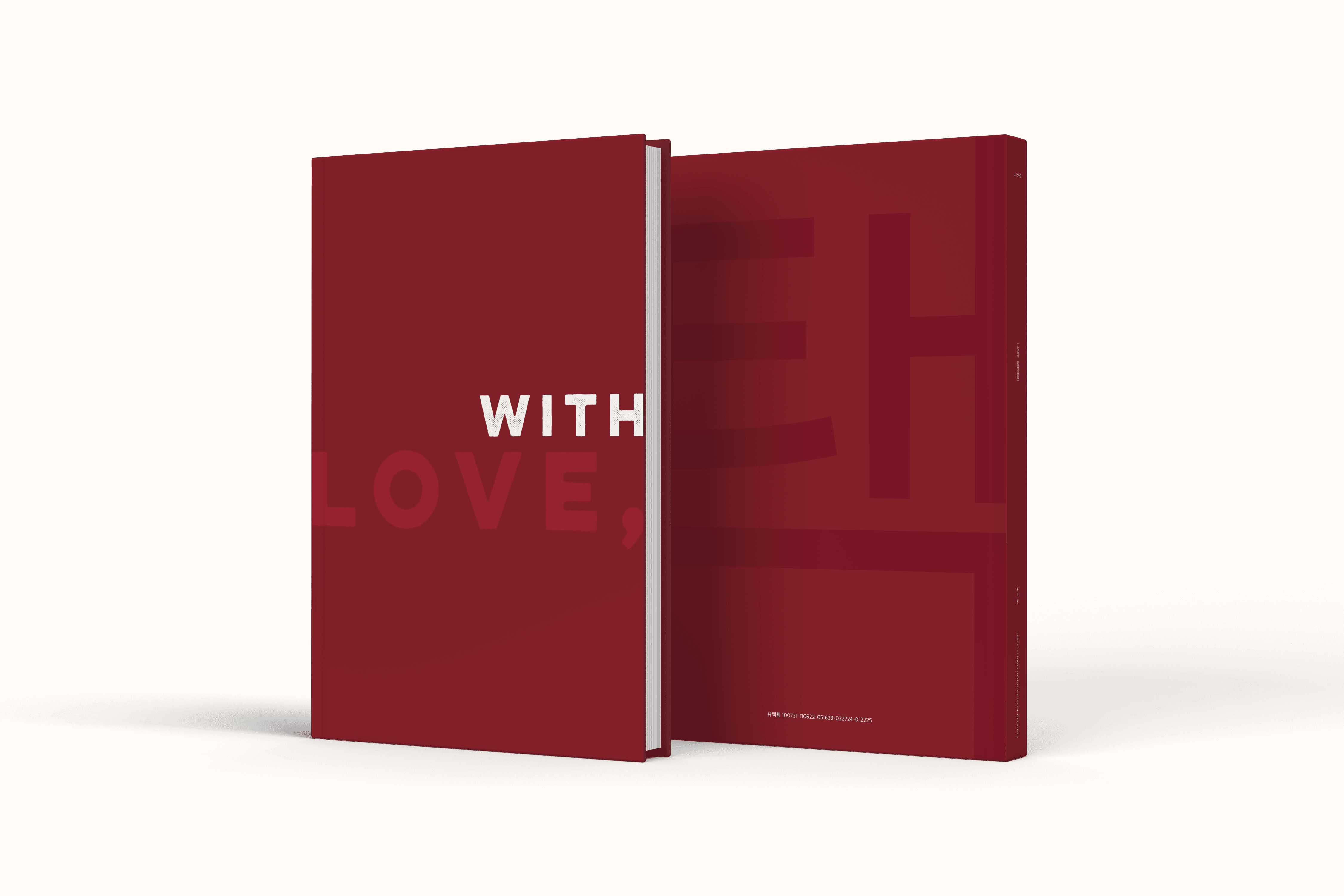
An intimate project showcasing love in its many forms and manifestations, with the addition of personal letters and notes.
An intimate project showcasing love in its many forms and manifestations, with the addition of personal letters and notes.
Overview
Publication, Editorial
83 pages, 7 x 10 inches
2024-2025
English
Timeline
5 months
(January-April 2024)
(April 2025)
Tools
Illustrator, InDesign
View Book
Time may remind us of what we've lost, but it also whispers of all the love we’ve yet to find.
An intimate editorial publication designed to guide the reader through love, loss, and healing using pacing, typography, and personal correspondence as narrative devices.
With love, was never just a goodbye. It was a way to speak the unsaid, to honour a love that shaped me, and a confession of all the love I had. This is a dedication to my first love, a reflection of all that was and all that remains. A soft testament that time, though slow, can be kind to healing hearts.
This book was always crafted with love—nothing less, nothing more. It was always meant as a love letter, but quietly became the last one, unsent, and marking the end. These pages carry unfiltered emotions and untouched words, preserved in their purest state.
Overview
Publication, Editorial
83 pages, 7 x 10 inches
2024-2025
English
Timeline
5 months
(January-April 2024)
(April 2025)
Tools
Illustrator, InDesign
View Book
Time may remind us of what we've lost, but it also whispers of all the love we’ve yet to find.
An intimate editorial publication designed to guide the reader through love, loss, and healing using pacing, typography, and personal correspondence as narrative devices.
With love, was never just a goodbye. It was a way to speak the unsaid, to honour a love that shaped me, and a confession of all the love I had. This is a dedication to my first love, a reflection of all that was and all that remains. A soft testament that time, though slow, can be kind to healing hearts.
This book was always crafted with love—nothing less, nothing more. It was always meant as a love letter, but quietly became the last one, unsent, and marking the end. These pages carry unfiltered emotions and untouched words, preserved in their purest state.
Guiding Question
How can a printed publication use pacing, restraint, and materiality to hold love, loss, and healing without overwhelming the reader?
Concept
Ideation & Concept
Initially, I knew I wanted to create a print about love, and the many forms it manifests as. This set the direction of gathering content of different forms of love, since I was also in love at the time, but as the book progressed and I alongside it—it changed into a project of closure because my love had no where to go. This progression marks that love doesn't disappear but remains, and you continue on, learning to love yourself in the process.
Ideation & Concept
Initially, I knew I wanted to create a print about love, and the many forms it manifests as. This set the direction of gathering content of different forms of love, since I was also in love at the time, but as the book progressed and I alongside it—it changed into a project of closure because my love had no where to go. This progression marks that love doesn't disappear but remains, and you continue on, learning to love yourself in the process.
Structure
Love
Love is where it all begins.
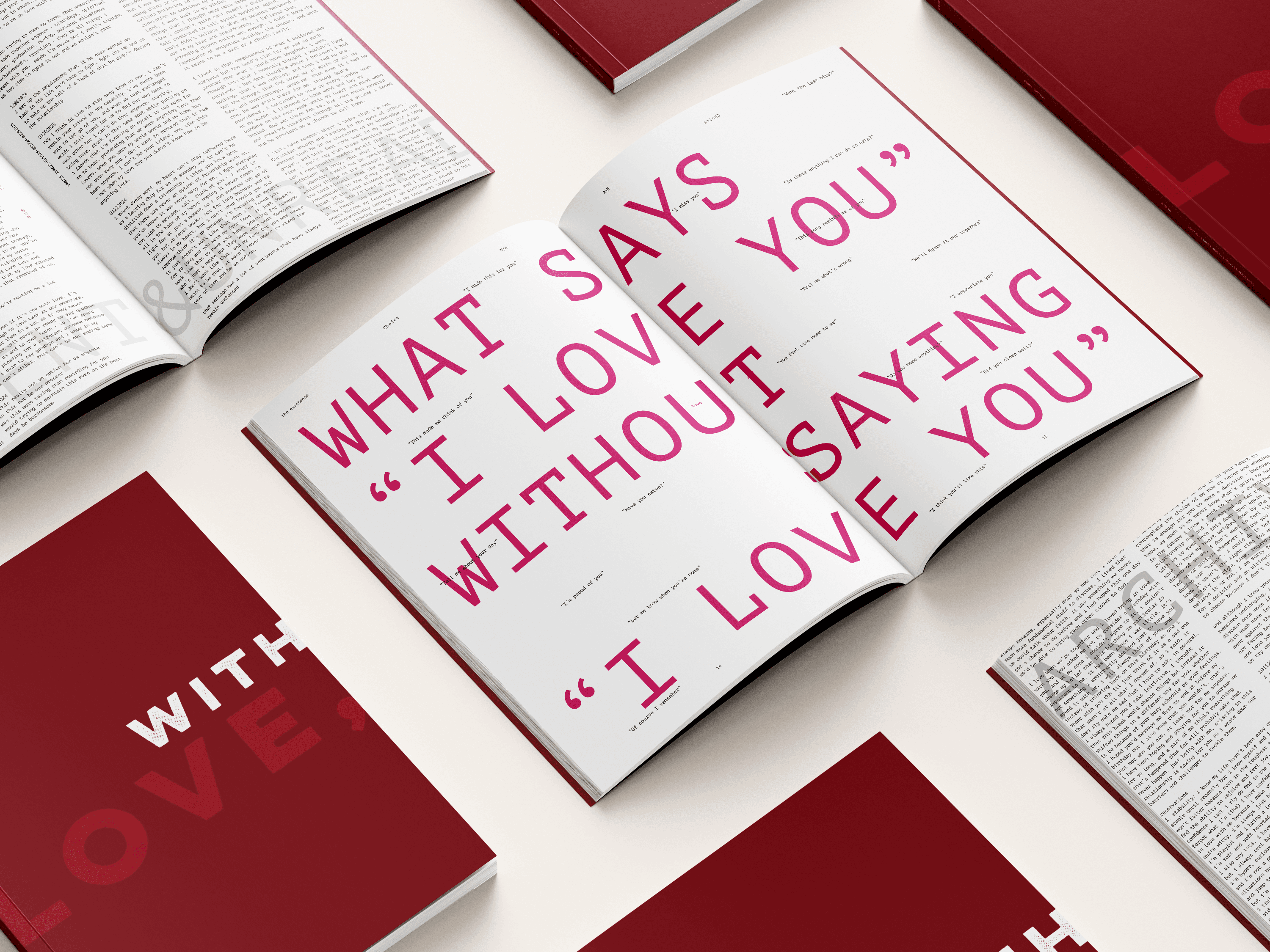
This chapter explores the act of falling in love. Love is where it all begins. This section holds the weight and warmth of firsts—the first gaze, the first laugh, the first “I love you.” It's where memories are laced with butterflies and late-night phone calls, where affection is unfiltered, raw, and endless. Here, love lives in its many forms: tender, chaotic, exhilarating, and overwhelming.
Love is warm and immersive, with fuller spreads and a denser rhythm that reflects the intensity and immediacy of falling in love.
Loss
Loss is love’s shadow—proof that something mattered deeply.
This section captures the ache of absence, the quiet of unanswered messages, the finality of distance. It traces the fault lines love leaves behind when it breaks, yet still lingers in memory. Through these reflections, grief speaks softly but powerfully: of what could have been, of what wasn’t said, and of the longing that refuses to fade. It is messy, unresolved, and unbearably human. But it’s also a testament: that we were here, that we loved, and that we tried.
Loss becomes fragmented and restrained with reduced colour and and pacing slows through interruptions, pauses, and visual silence—echoing the disorientation and absence that follows heartbreak.
Heal
Healing does not arrive all at once. It comes in fragments—slow mornings, deeper breaths, a gentle return to self.
This final section is about remembering without breaking, about carrying love forward without letting it weigh you down. Healing is not forgetting but transforming. It’s learning that pain can sit beside joy, that letting go can be an act of love, and that hope always finds a way to rise. These pages are a quiet reclaiming of self, a love letter not just to someone else, but finally—to you.
Space increases, compositions loosen, and the rhythm becomes gentler and more resolved. Rather than closure, this section offers acceptance.
Structure
Love
Love is where it all begins.
This chapter explores the act of falling in love. Love is where it all begins. This section holds the weight and warmth of firsts—the first gaze, the first laugh, the first “I love you.” It's where memories are laced with butterflies and late-night phone calls, where affection is unfiltered, raw, and endless. Here, love lives in its many forms: tender, chaotic, exhilarating, and overwhelming.
Love is warm and immersive, with fuller spreads and a denser rhythm that reflects the intensity and immediacy of falling in love.
Loss
Loss is love’s shadow—proof that something mattered deeply.
This section captures the ache of absence, the quiet of unanswered messages, the finality of distance. It traces the fault lines love leaves behind when it breaks, yet still lingers in memory. Through these reflections, grief speaks softly but powerfully: of what could have been, of what wasn’t said, and of the longing that refuses to fade. It is messy, unresolved, and unbearably human. But it’s also a testament: that we were here, that we loved, and that we tried.
Loss becomes fragmented and restrained with reduced colour and and pacing slows through interruptions, pauses, and visual silence—echoing the disorientation and absence that follows heartbreak.
Heal
Healing does not arrive all at once. It comes in fragments—slow mornings, deeper breaths, a gentle return to self.
This final section is about remembering without breaking, about carrying love forward without letting it weigh you down. Healing is not forgetting but transforming. It’s learning that pain can sit beside joy, that letting go can be an act of love, and that hope always finds a way to rise. These pages are a quiet reclaiming of self, a love letter not just to someone else, but finally—to you.
Space increases, compositions loosen, and the rhythm becomes gentler and more resolved. Rather than closure, this section offers acceptance.
Design
Pacing & Rhythm
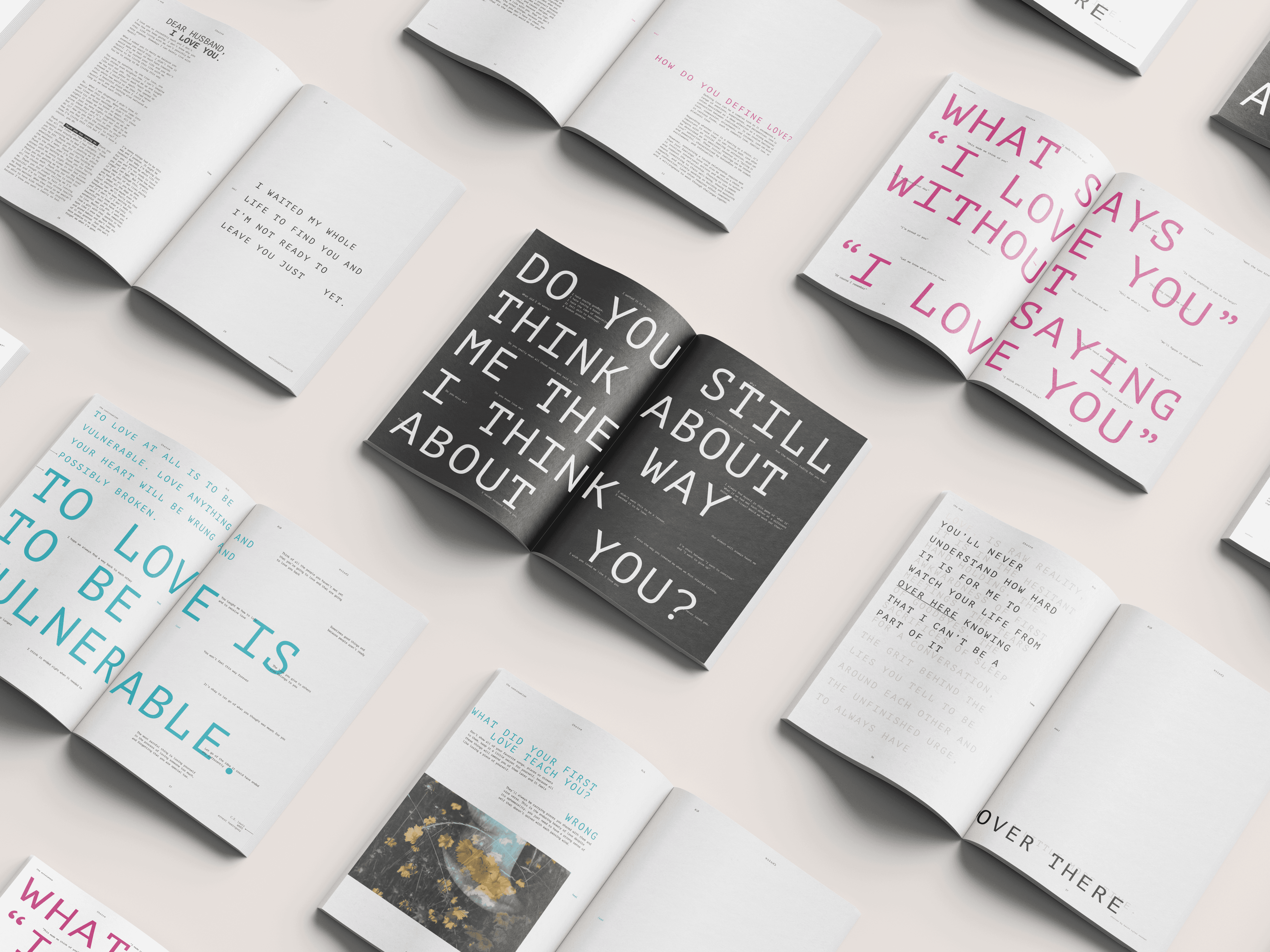
The book’s pacing mirrors emotional progression. Dense pages of text are balanced with lighter spreads of imagery and quotes, allowing moments of pause, reflection, and emotional breathing. White space functions as pauses of silence—marking intensity, hesitation, and release.
It opens immediately into love; warm, full, and immersive, before transitioning into heartbreak, where colour recedes and the visual tone becomes monochromatic. Healing emerges gradually through increased white space and softer compositions.
Pacing & Rhythm
The book’s pacing mirrors emotional progression. Dense pages of text are balanced with lighter spreads of imagery and quotes, allowing moments of pause, reflection, and emotional breathing. White space functions as pauses of silence—marking intensity, hesitation, and release.
It opens immediately into love; warm, full, and immersive, before transitioning into heartbreak, where colour recedes and the visual tone becomes monochromatic. Healing emerges gradually through increased white space and softer compositions.
Spec Board
Typography
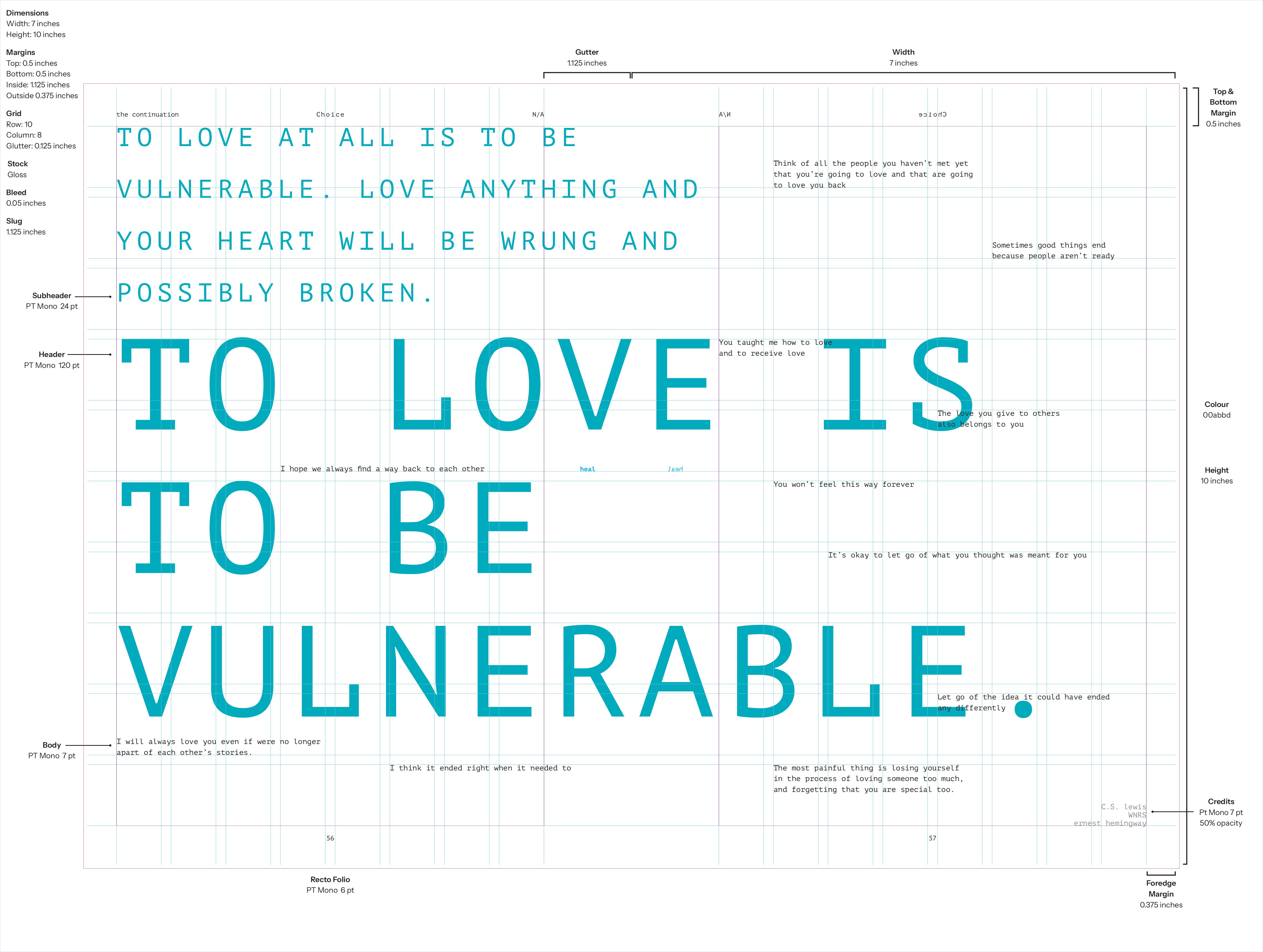
PT Mono
PT Mono
DESIGNED BY PARATYPE
Appearance - Monospaced
Feeling - Vintage
Feeling - Sincere
A slab serif was chosen for the body text due to its assertive, grounded nature, reinforcing the publication as a statement of conviction. Historically associated with print culture, the typeface supports ideas meant to be declared and held. The typography communicates intentionality and unapologetic honesty—asserting that these words, emotions, and experiences matter and deserve to be seen and validated.
Typography
PT Mono
DESIGNED BY PARATYPE
Appearance - Monospaced
Feeling - Vintage
Feeling - Sincere
A slab serif was chosen for the body text due to its assertive, grounded nature, reinforcing the publication as a statement of conviction. Historically associated with print culture, the typeface supports ideas meant to be declared and held. The typography communicates intentionality and unapologetic honesty—asserting that these words, emotions, and experiences matter and deserve to be seen and validated.
Colour & Form
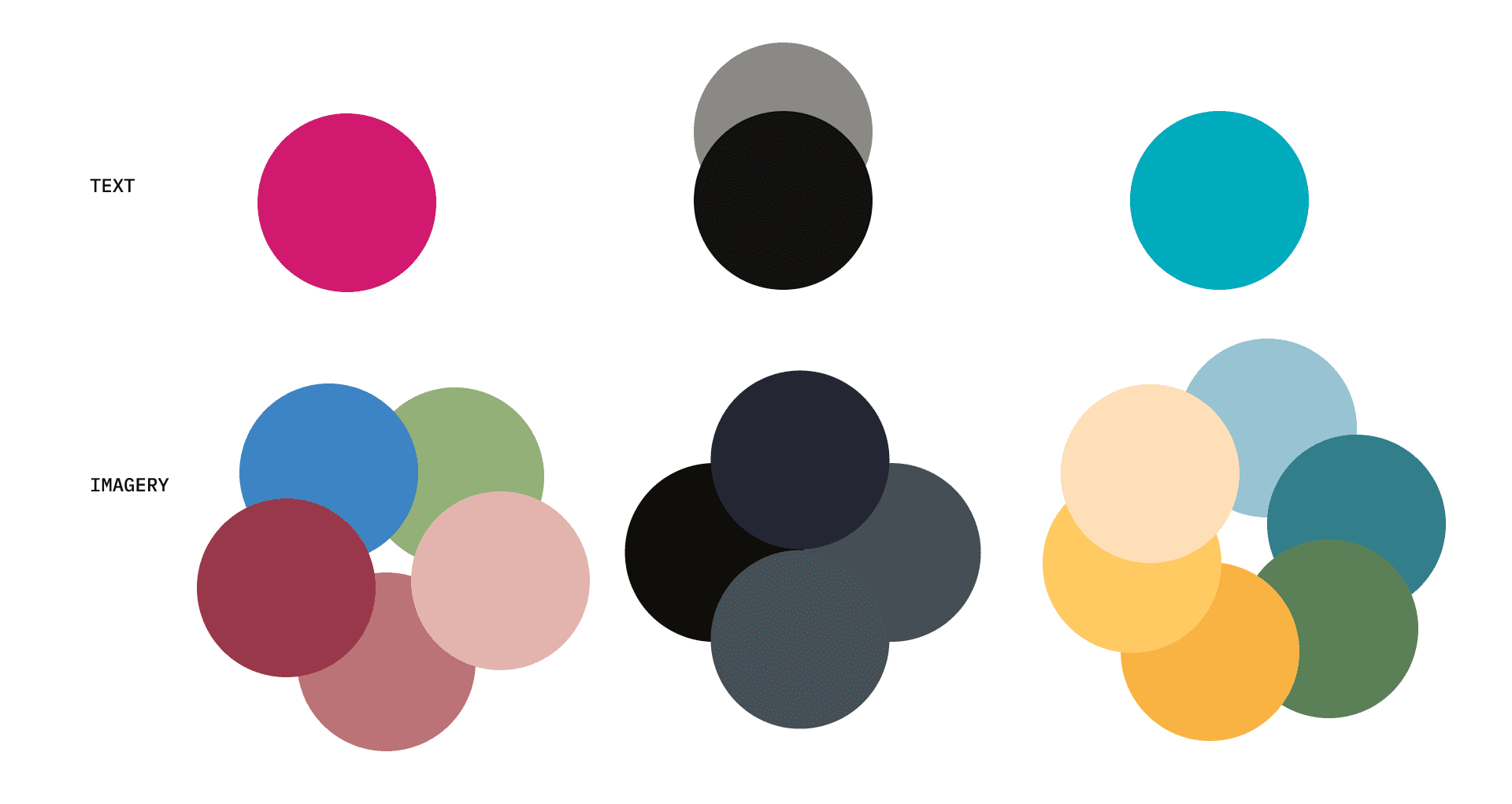
The visual language is deliberately restrained. Minimal colour and expressive restraint keep emotional content central and without distraction. The color palette progresses from saturated and expressive, into greys and monochromatic, and finally into softened, lighter tones. This shift mirrors the emotional arc of the book, moving from intensity and fullness, through absence and grief, and toward gentleness and acceptance.
A consistent grid and typographic system anchors the book, maintaining cohesion as emotional tone shifts across sections.
Colour & Form
The visual language is deliberately restrained. Minimal colour and expressive restraint keep emotional content central and without distraction. The color palette progresses from saturated and expressive, into greys and monochromatic, and finally into softened, lighter tones. This shift mirrors the emotional arc of the book, moving from intensity and fullness, through absence and grief, and toward gentleness and acceptance.
A consistent grid and typographic system anchors the book, maintaining cohesion as emotional tone shifts across sections.
Format
I chose print because I wanted readers to be able to immerse themselves in not only the book but the emotions they’re feeling. This publication is perfect bound to open fully flat, encouraging slow, intentional reading rather than passive skimming, reinforcing its role as something to be sat with, not consumed quickly.
Format
I chose print because I wanted readers to be able to immerse themselves in not only the book but the emotions they’re feeling. This publication is perfect bound to open fully flat, encouraging slow, intentional reading rather than passive skimming, reinforcing its role as something to be sat with, not consumed quickly.
Challenges
Initially, the publication relied heavily on sourced imagery and text collected from external references. Over time, I realized this approach lacked emotional depth and personal resonance. The work felt visually cohesive but emotionally distant.
In response, I made the decision to remove much of the sourced content and turn inward, using my own letters, photographs, and written archives as primary material. This shift fundamentally changed the project. Unearthing my own unresolved thoughts revealed how much remained unsaid, which ultimately became the archive of letters included at the end of the book. As more of myself entered the work, the publication grew significantly stronger, both emotionally and conceptually.
Initially, the publication relied heavily on sourced imagery and text collected from external references. Over time, I realized this approach lacked emotional depth and personal resonance. The work felt visually cohesive but emotionally distant.
In response, I made the decision to remove much of the sourced content and turn inward, using my own letters, photographs, and written archives as primary material. This shift fundamentally changed the project. Unearthing my own unresolved thoughts revealed how much remained unsaid, which ultimately became the archive of letters included at the end of the book. As more of myself entered the work, the publication grew significantly stronger, both emotionally and conceptually.
Final


Outcome & Reflection
Because this was a personal dedication to someone whom I had an intimate relationship with, I struggled with finishing the publication overall. We ended things and I couldn't find the motivation to continue working on it because it was just too much of a reminder of what I had lost but eventually, a year later, I continued working on it because I felt like I was stuck in what was and unable to move on.
I included the an 'Archives' section at the end, which includes unsent messages I never got to send—in the relationship and out of it. They hold significance because I don't believe I'll ever get a chance to say everything I felt. I kept so many old letters in my notes app dated from the beginning of when we first met in 2022, and I decided if I wasn't going to have a chance to send them to anyone—to have the recipient read it, I was going to express it in my work.
In many ways, finishing this book was my way of choosing closure on my own terms. I no longer needed the letters to be received in order for them to be real. Their existence alone was enough. Through creating this publication, I realized it wasn’t about reaching someone else anymore—it was about reaching a version of myself who needed to be heard, held, and accepted. This is my final love letter. Not to him, but to everything I once felt, and to the person I’ve become because of it.
Outcome & Reflection
Because this was a personal dedication to someone whom I had an intimate relationship with, I struggled with finishing the publication overall. We ended things and I couldn't find the motivation to continue working on it because it was just too much of a reminder of what I had lost but eventually, a year later, I continued working on it because I felt like I was stuck in what was and unable to move on.
I included the an 'Archives' section at the end, which includes unsent messages I never got to send—in the relationship and out of it. They hold significance because I don't believe I'll ever get a chance to say everything I felt. I kept so many old letters in my notes app dated from the beginning of when we first met in 2022, and I decided if I wasn't going to have a chance to send them to anyone—to have the recipient read it, I was going to express it in my work.
In many ways, finishing this book was my way of choosing closure on my own terms. I no longer needed the letters to be received in order for them to be real. Their existence alone was enough. Through creating this publication, I realized it wasn’t about reaching someone else anymore—it was about reaching a version of myself who needed to be heard, held, and accepted. This is my final love letter. Not to him, but to everything I once felt, and to the person I’ve become because of it.
What's Next
Given more time, I would explore expanding this project into multiple volumes. This could take the form of a second installment or individual books dedicated to Love, Loss, and Healing. Each section carries enough emotional and narrative weight to stand on its own.
What's Next
Given more time, I would explore expanding this project into multiple volumes. This could take the form of a second installment or individual books dedicated to Love, Loss, and Healing. Each section carries enough emotional and narrative weight to stand on its own.